
REMEMBERING WENDELL BERRY: the art of community
By Director, Joe Duncan
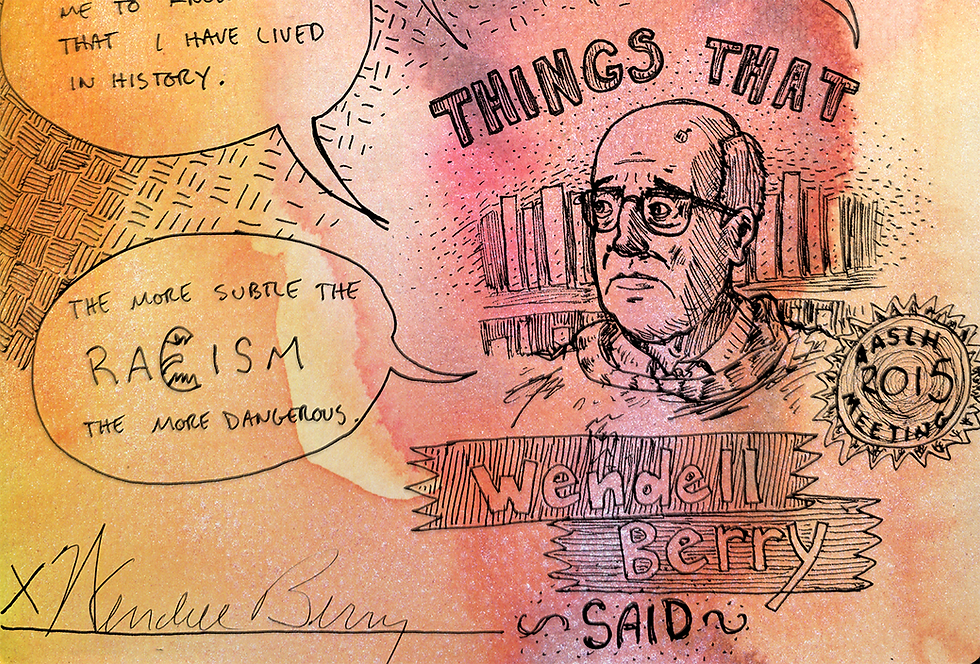
Several years ago, I sat in an audience at the The American Association for State and Local History (AASLH) listening to Wendell Berry speak with a sketchbook open on my lap. I doodled while he talked.
I wasn’t really trying to make a portrait of him. Drawing has always been one of the ways I pay attention, so I drew his face and scribbled down the things he said that I wanted to remember. After the talk, I asked him to sign the page. He did, and I’ve kept it ever since.
I pulled that drawing back out after hearing of Berry’s passing yesterday, and what surprised me was how little attention I paid to the signature. Instead, I found myself reading the notes I had hurriedly written around him. There are thoughts about history and imagination, ancestors and descendants, and the responsibility we have for what we leave behind. Apparently, sitting in that room years ago, those were the things I thought were worth holding onto.

There is something appropriate about that. Berry spent much of his life asking us to pay attention, to land, to work, to language, to our neighbors, to what has been handed down to us and what we are handing down in return.
He wrote often about farming, but I’ve never thought his real subject was agriculture alone. Farming gave him a way to think about a much larger question: What does it mean to belong to a place?
Belonging, in Berry’s sense, is different from simply living somewhere. It implies a relationship, and relationships come with obligations. You learn the history. You get to know the people. You notice what is disappearing. You contribute what you know. You accept some responsibility for what happens next.
Over the past year or so, as we’ve been trying to figure out what an art guild should actually do in a small Kentucky town, I keep finding myself circling those same ideas.
It would be easy to define the Princeton Art Guild by the things we produce. We hang exhibitions and teach classes. We make murals, host musicians, bring artists to town, make zines, offer workshops and fill tables with art supplies. Those are the visible things, and they matter. But increasingly, I suspect they aren’t the actual work.
The actual work may be cultivation. That is a word Berry understood.
A healthy farm isn’t simply a machine for extracting as much as possible from a piece of land. Its health depends upon relationships that have to be tended over time. Soil has to be replenished. Knowledge has to be accumulated and passed along. The person doing the work has to pay attention to the particular place rather than treating every field as interchangeable.
I think a community’s creative life works much the same way.

You can bring in a great exhibition, hire a great artist, or put on a great event, but you can’t simply import a creative community. You have to cultivate one.
And cultivation often looks remarkably ordinary.
Someone walks through the door convinced they aren’t creative and eventually makes something anyway. A person who knows how to crochet sits beside someone who doesn’t. A musician meets somebody else to play with. A child spends enough time in an art building that it stops feeling like a special place containing precious objects made by important people and starts feeling like a place where they belong.
Someone has an idea. Someone else knows how to do part of it. A third person knows who to call. There is a table available, somebody finds the right tool, and eventually something exists that didn’t exist before.
None of this is particularly spectacular. That is precisely why it matters.
For a long time, arts organizations have been asked to demonstrate their value through production. How many exhibitions did you mount? How many classes did you teach? How many people came through the door? Those are useful questions, and we count those things too. But they can miss something that is much harder to measure: the relationships that form around making.
Sometimes the art is the product.
Sometimes the real product is that two people who might never otherwise have known one another spent an afternoon sitting across a table together.
That distinction has helped me better understand why we keep calling ourselves a guild, not a gallery. A gallery is primarily a place for encountering things that have already been made. A guild, at least as we are trying to understand the word, is about participating in the making. It is a collection of people, knowledge, tools and relationships. It is a structure designed to keep that collection of assets alive from one generation to the next.
That also means reconsidering who gets to participate.
We have inherited a strange idea about creativity: that it belongs to a particular category of people called artists. Some people have talent and some don’t. Some people are creative and everyone else should probably leave the paintbrushes alone.
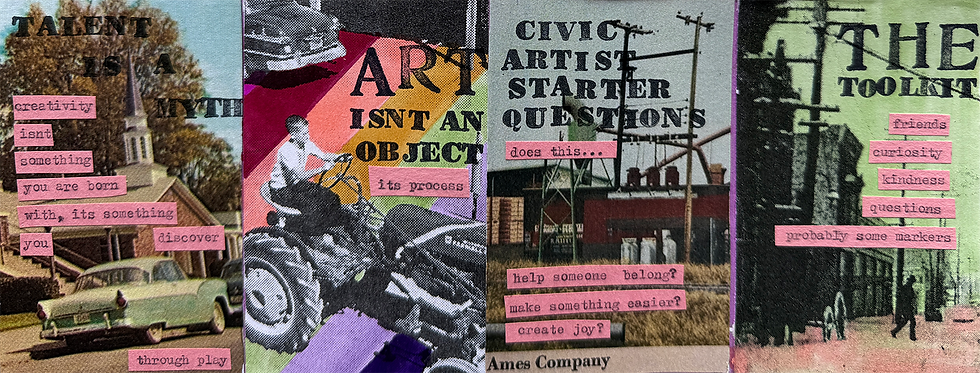
We’ve started saying something different at the Guild: Talent is a myth.
That doesn’t mean skill is a myth. Skill is real, and good craftsmanship deserves respect. But skill has a history. Before the good paintings there were bad paintings. Before the song was played beautifully, it was played poorly. Skill grows through attention, practice, failure, repetition, teachers, neighbors, access to tools, and time.
So perhaps the role of a healthy creative community isn’t to identify the talented people and give them a platform. Perhaps it is to give as many people as possible the opportunity to practice, and fail, and grow.
Looking again at my drawing of Berry, I realized that the page itself is a tiny example of this idea. I didn’t just attend a lecture and receive what was being presented to me. I responded to it by making something. I listened, drew, wrote, interpreted and recorded. Berry added his name to it, and years later the page carries that experience forward. It is an anchor that I return to when I need clarity.
Paying attention became participation, and participation left something behind. That thing became the thing you're reading right now. It was a very small creative act that has continued to ripple and grow.
Berry’s work has always made me suspicious of our tendency to confuse scale with importance. There is a particular pressure in rural places to believe that meaningful cultural work is happening somewhere else. The important artists are somewhere else. The innovative ideas are somewhere else. The resources are somewhere else. Success, therefore, means either leaving or figuring out how to make our place look a little more like theirs.
Berry’s life offered a very different proposition. He left Kentucky, encountered a much larger world, and chose to return home. He demonstrated that a life rooted deeply in one particular place need not be a small life.
That matters to me, and it matters to the work we are doing at the Guild.
Our job isn’t to make Princeton into Nashville or Louisville or New York. Our job is to pay attention to Princeton. Our job is to help Princeton be its best and authentic self.
What do people here know? What do they make? What do they remember? What has been lost? What needs tending? Who has a skill they could pass along? Who needs access to a tool they could never justify buying themselves? Who needs somewhere to go? What happens if we put those people in the same room?
An art organization responding to those questions may not always look like what we traditionally imagine an art organization should look like. Sometimes the answer will be an exhibition or a painting class. But it might also be a jam session, a community craft table, a public sign, a zine, a mural, a shared meal, a better-designed public space, or simply a table and chair waiting for someone who doesn’t want to make something alone.
All of that has gradually led me toward a way of describing the Guild’s work that should be said out loud: Creativity is a form of community care.
Making something with another person creates a relationship. Teaching someone a skill preserves knowledge. Giving people access to tools gives them agency. Making a place where people can gather gives them somewhere to belong. Artists help communities notice things. Designers help communities solve things. Musicians give us reasons to gather. Writers help us remember. Children remind us that imagining something differently is still possible.
None of those things requires us to become famous. They require us to become useful to one another.
I think that may be what I find most valuable in Berry’s example. He reminds us that there is dignity in choosing a place, paying attention to it, and accepting some responsibility for its care. You learn what you can. You contribute what you have. You pass some of it along. You leave some things better than you found them.
Then you keep showing up.
Looking at that old drawing now, I’m grateful that I happened to have a pen in my hand that day. I’m grateful I paid attention. And I’m especially grateful for the Kentuckian sitting at the front of the room who spent a lifetime reminding us that the places we inherit are not simply ours to consume. They are ours to care for.
Our doors are open. Bring in your knowledge, your curiousity, and your ideas. Let's choose this place and cultivate it together.


